
Meta modelSatya NadellaMicrosoft Chairman & CEO
Think of it as a meta model, right? That’s the most important thing.SourceMorgan Stanley TMT Conference · 2026
An open, programmable decision layer for models and compute.
Think of it as a meta model, right? That’s the most important thing.SourceMorgan Stanley TMT Conference · 2026

The future is multi-models and you’ll want to customize your router the same way you customize your code!SourcePublic post on open-source router systems

We’ve become system optimizers, still optimizing every component, but then equally looking at how you optimize how each of the pieces come together.SourcetheCUBE at RAISE Summit · 2026

Enterprise AI needs control over cost, privacy, and policy.
SourceTechnically Speaking / Red Hat · 2026
A smart router sends every task to its best-fit model.
SourceNVIDIA Live at CES · 2026As of October 10, 2026, vLLM Semantic Router models on Hugging Face total about 143,000 downloads across 96 models in 6 collections—Decision, Vela, and MoM families.
SourceHugging Face · vllm-sr collections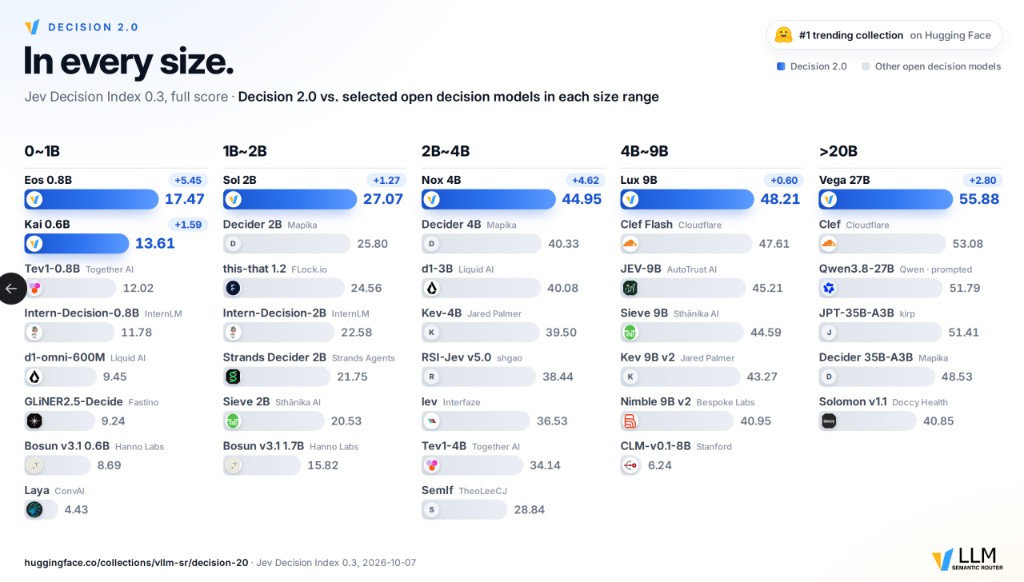
Decision 2.0 reached #1 on Hugging Face trending collections, leading selected open decision models across every size range on the Jev Decision Index 0.3.
SourceHugging Face collection · Decision 2.0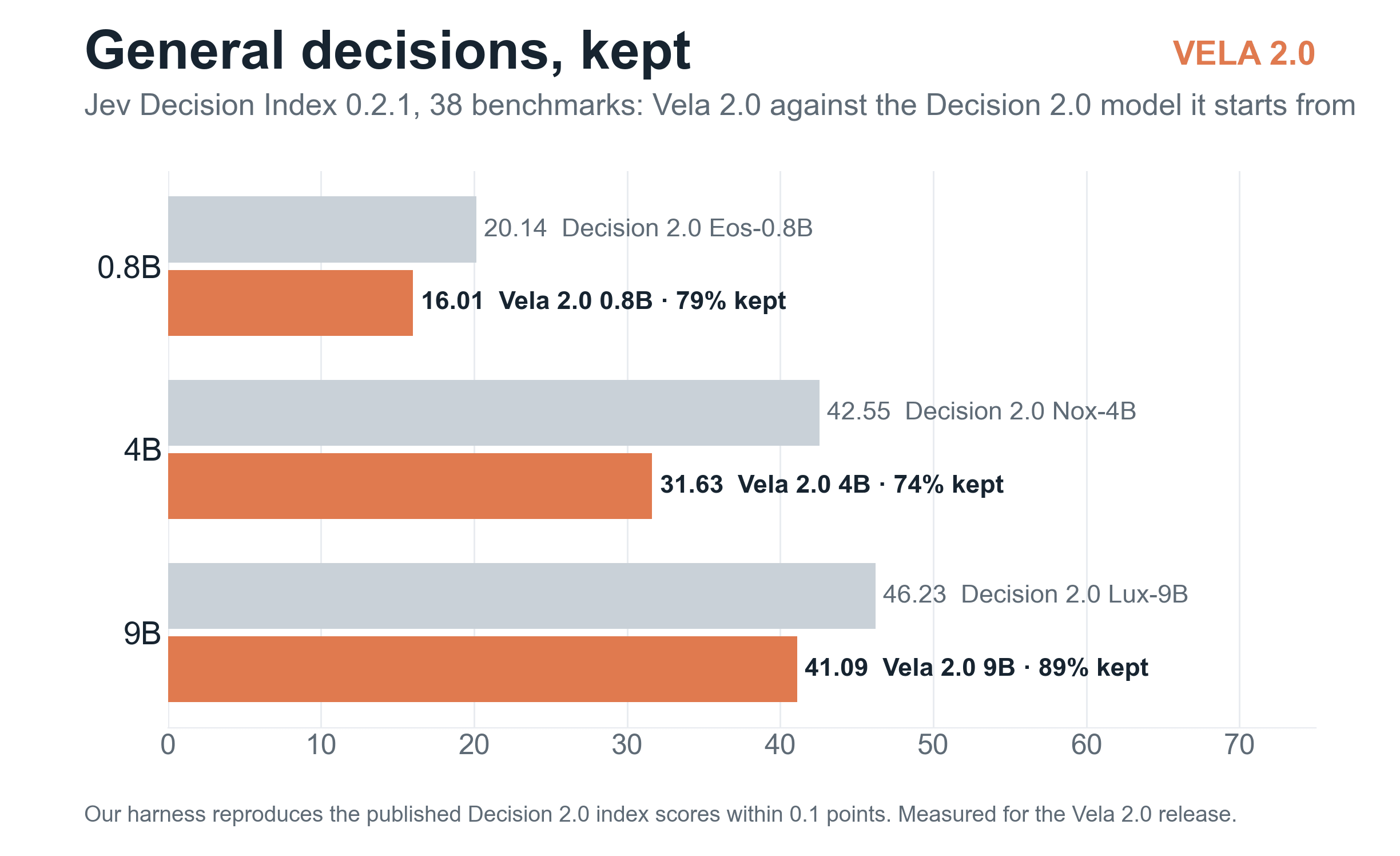
multimodalart, author of the Jev Decision Index Space, upvoted the Decision 2.0 collection on Hugging Face—community recognition from the benchmark that tracks open decision models.
SourceHugging Face collection · Decision 2.0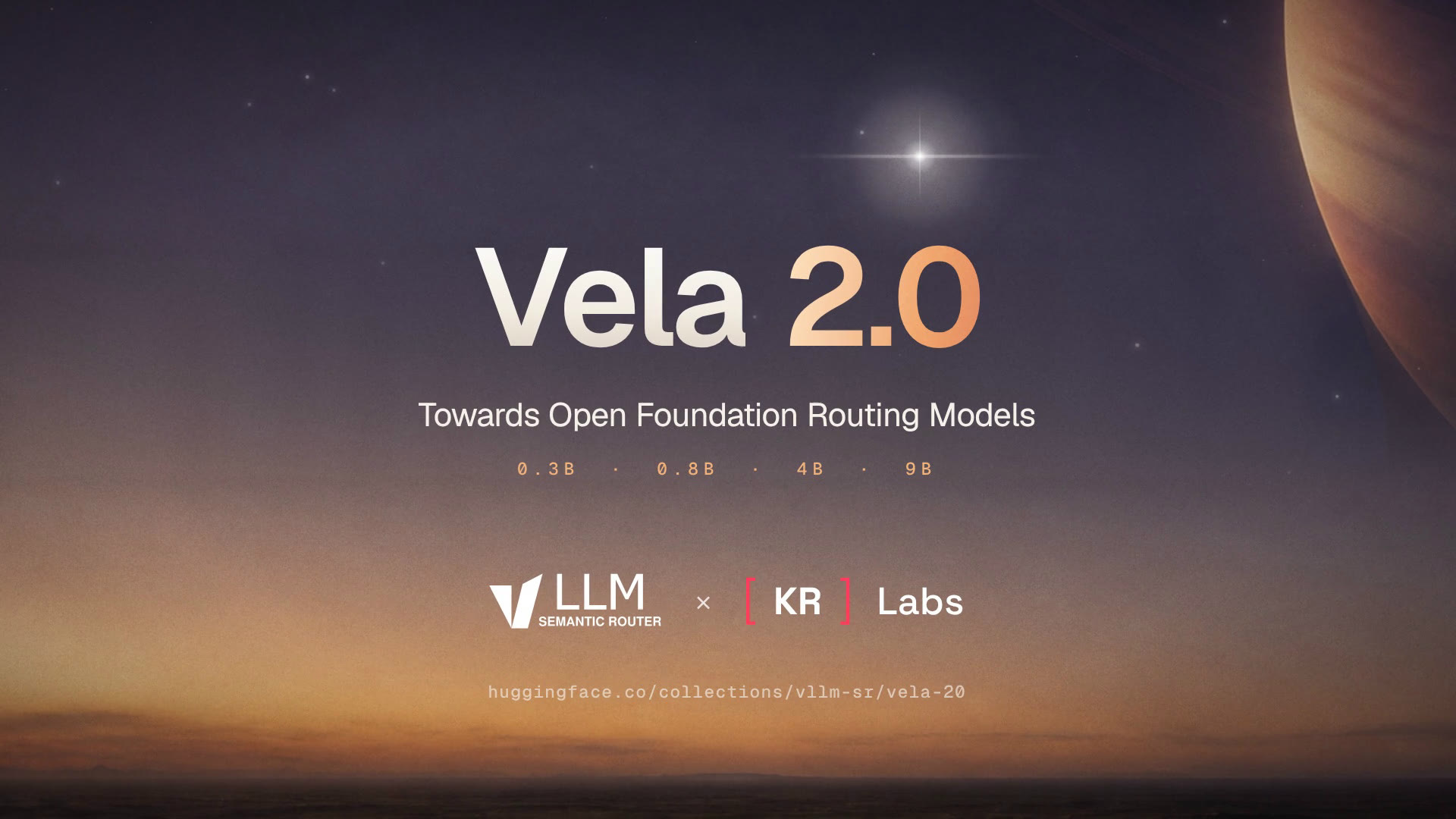
Vela 2.0 ships four open routing models that answer safety, domain, PII, and hallucination questions in one call—with span-level answers.
SourceLaunch post · Vela 2.0
AlphaSignal reported on Vela 2.0: four open routing models that fold nine LLM router checks into a single call.
SourceAlphaSignal · Vela 2.0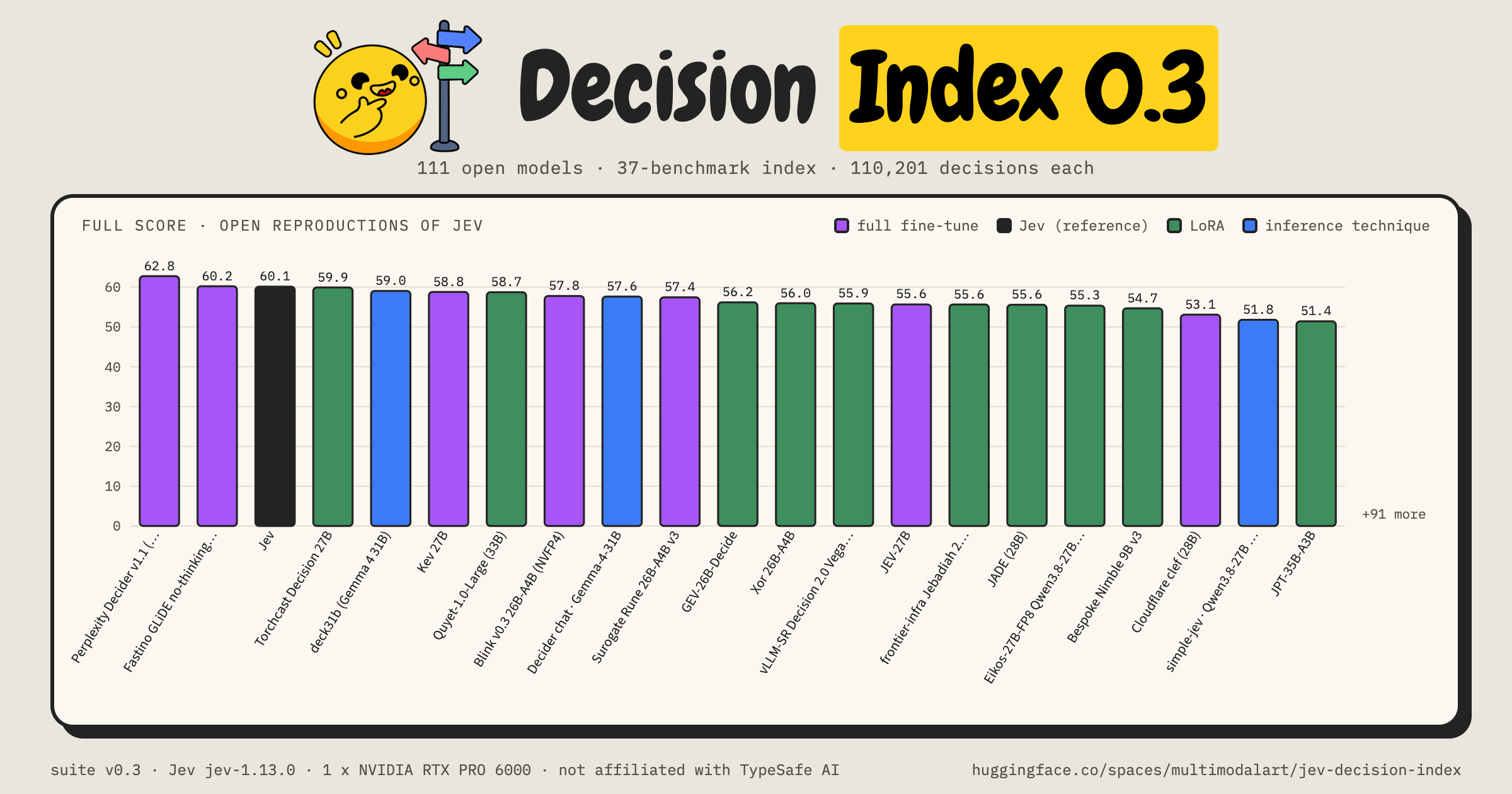
The community Jev Decision Index Space tracks open decision-model benchmarks and news, with Decision 2.0 models listed among them.
SourceHugging Face Space · Jev Decision Index
v0.4 Hermes shipped open Decision models and Vela classification models inside one improving Mixture-of-Models system.
SourceRelease post · v0.4 Hermescurl -fsSL https://vllm-sr.ai/install.sh | bash -s -- --channel devDevelopment channelMatches the latest docs, including the built-in model runtime.
Demos, deployments, and ideas from the community.
Choose models and compute for each request.
Different strengths. One model fleet.
Route to the backends you configure.
You configure where inference runs.
Set priorities for each task.


Bring the right intelligence to every request.
Context, intent, safety, preferences, and system state.
11 selection algorithms and 5 loopers.
19 papers on routing, safety, and inference.
Route chat through a Decision Engine, or call model intelligence directly. Both paths share the frontend and scalable Serving Engine.
Listeners, authentication, and API contracts.
/v1/chat/completions/v1/responses/v1/systemoneAlias: /v1/decisionsEach entrypoint resolves to an isolated recipe.
Choose a model deployment, then a ready replica.
Route Chat, Messages, and Responses to your model backends. Keep native decisions available alongside routing.
vllm-sr serve vllm-sr/Decision-2.0-Kai-0.6BCall /v1/chat/completions or /v1/messages.
Start the same frontend and model workers with routing disabled. Your application owns the next step.
vllm-sr serve -e vllm-sr/Decision-2.0-Kai-0.6BCall /v1/systemone with an explicit published model.
Development channelChoose the composition at CLI startup.
Keep private domain knowledge on premises with open models running on your GPUs. Use external frontier models for requests your routing policy allows.
This animation illustrates a configured privacy policy: internal domain knowledge is routed to open models on on-prem GPUs, while public requests can use external frontier closed models when eligible. Privacy, locality, and access constraints apply before model selection.
The ideas that move inference forward.
vLLM Semantic Router Team
arXiv Technical Report
We introduce vLLM Semantic Router, a signal-driven decision routing framework for Mixture-of-Modality deployments that composes heterogeneous signals into deployment-specific routing policies across cost, privacy, latency, and safety constraints.
Huamin Chen, Xunzhuo Liu, Bowei He, Fuyuan Lyu, Yankai Chen, Xue Liu, Yuhan Liu, Junchen Jiang
arXiv Technical Report
We synthesize the project’s recent routing, fleet, multimodal, and governance results into the Workload-Router-Pool (WRP) architecture, connecting signal-driven routing to a full-stack inference optimization framework and outlining future research directions across workload, router, and pool design.
Xunzhuo Liu, Bowei He, Xue Liu, Andy Luo, Haichen Zhang, Huamin Chen
arXiv Technical Report
We formalize the visual confused deputy as a security failure mode in computer-using agents and introduce a dual-channel guardrail that independently checks click targets and action reasoning before execution.
Huamin Chen, Xunzhuo Liu, Junchen Jiang, Bowei He, Xue Liu
arXiv Technical Report
We introduce Outcome-Aware Tool Selection (OATS), an offline embedding refinement method that improves semantic-router tool ranking under single-digit millisecond CPU budgets without adding serving-time model inference.
Xunzhuo Liu, Bowei He, Xue Liu, Andy Luo, Haichen Zhang, Huamin Chen
arXiv Technical Report
We propose Adaptive VLM Routing (AVR), which estimates action difficulty and routes computer-use agent steps to the cheapest model that still satisfies a target reliability threshold.
Xunzhuo Liu, Bowei He, Xue Liu, Andy Luo, Haichen Zhang, Huamin Chen
arXiv Technical Report
We combine Flash Attention, prompt compression, and near-streaming body processing to cut routing latency from seconds to tens of milliseconds while keeping the router lightweight enough to share hardware with serving.
Huamin Chen, Xunzhuo Liu, Yuhan Liu, Junchen Jiang, Bowei He, Xue Liu
arXiv Technical Report
We present a queueing-theory-grounded fleet planner and discrete-event simulator for sizing multi-pool LLM GPU fleets against P99 TTFT targets, without requiring hardware profiling runs up front.
Huamin Chen, Xunzhuo Liu, Yuhan Liu, Junchen Jiang, Bowei He, Xue Liu
arXiv Technical Report
We derive the minimum-cost two-pool LLM fleet directly from the workload CDF and P99 TTFT target, then use Compress-and-Route to make the optimal boundary deployable in practice.
Huamin Chen, Xunzhuo Liu, Yuhan Liu, Junchen Jiang, Bowei He, Xue Liu
arXiv Technical Report
We derive the 1/W law showing that tokens per watt roughly halve whenever the serving context window doubles, making context-length routing topology a larger energy-efficiency lever than a pure GPU generation upgrade.
Ádám Kovács, Bowei He, Xue Liu, István Boros, Szilveszter Tóth, Gábor Recski
EMNLP 2026 - GroundLM Workshop
We introduce a unified benchmark for span-level hallucination detection over code, tool output, structured documents, and existing natural-language RAG datasets, built by injecting localized hallucinations with exact character labels into grounded correct answers. Our fine-tuned Qwen3.5-2B detector reaches 0.689 span-F1 on the unified test set and 0.60 on the code-agent source, substantially outperforming LettuceDetect-large and the strongest zero-shot LLM judges evaluated.
Xunzhuo Liu, Hao Wu, Huamin Chen, Bowei He, Xue Liu
arXiv Technical Report
We show how probabilistic ML predicates in policy languages can silently co-fire on the same query, and implement conflict detection plus a softmax-based prevention mechanism in the Semantic Router DSL.
Huamin Chen, Xunzhuo Liu, Bowei He, Xue Liu
arXiv Technical Report
We extend the Semantic Router DSL from stateless, per-request routing to multi-step agent workflows, emitting verified decision nodes for orchestration frameworks, Kubernetes artifacts, YANG/NETCONF payloads, and protocol-boundary gates from a single declarative source file.
Xunzhuo Liu, Bowei He, Xue Liu, Andy Luo, Haichen Zhang, Huamin Chen
arXiv Technical Report
We show that conversational memory and retrieval-grounded routing let a lightweight 8B model recover most of a 235B model’s performance on persistent user-specific queries while cutting effective inference cost by 96%.
Xunzhuo Liu, Bowei He, Xue Liu, Haichen Zhang, Huamin Chen
SIGIR 2026 Industry Track
We present a real-time verification component for long-document RAG that processes contexts up to 32K tokens, balancing latency and grounding coverage so interactive systems can detect unsupported answers without falling back to truncated checks.
Huamin Chen, Xunzhuo Liu, Junchen Jiang, Bowei He, Xue Liu
arXiv Technical Report
We propose token-budget-aware pool routing, which estimates each request’s total token budget using a self-calibrating bytes-per-token ratio and dispatches it to short or long vLLM pools to cut fleet cost while avoiding KV-cache failures.
Chen Wang, Xunzhuo Liu, Yuhan Liu, Yue Zhu, Xiangxi Mo, Junchen Jiang, Huamin Chen
NeurIPS - MLForSys
We present a semantic router that classifies queries based on their reasoning requirements and selectively applies reasoning only when beneficial.
Chen Wang, Xunzhuo Liu, Yue Zhu, Alaa Youssef, Priya Nagpurkar, Huamin Chen
We present a category-aware semantic caching where similarity thresholds, TTLs, and quotas vary by query category, with a hybrid architecture separating in-memory HNSW search from external document storage.
Huamin Chen, Luay Jalil
Internet Engineering Task Force (IETF)
This document specifies the Semantic Inference Routing Protocol (SIRP), a framework for content-level classification and semantic routing in AI inference systems.
H. Chen, L. Jalil, N. Cocker
Internet Engineering Task Force (IETF) - Network Management Research Group
This document specifies multi-provider extensions for agentic AI inference APIs. Published: 20 October 2025. Intended Status: Informational. Expires: 23 April 2026.
Researchers and builders, working together.
 Maintainer
@AMD
 Maintainer
@Microsoft
 Maintainer
Software Engineer @Delta Electronics
 Maintainer
Senior Software Engineer, Data and AI @Red Hat
 Maintainer
Cloud-native Open Source Contributor
 Committer
Software Engineering Intern @Quid
 Committer
Software Engineer @Barclays
 Committer
Forward Deployed Engineer @Rebellions
 Committer
Member of Technical Staff @Nutanix
 Committer
Software & Data Engineer
 Committer
Co-founder & CTO @KR Labs
 Committer
GTM Tech Lead @Google
 Committer
Cloud-native Engineer @DaoCloud
 Committer
Computer Science Engineer @Intuit
 Committer
PMTS, Silo AI @AMD
 Committer
Junior Software Engineer (Research Scientist) @Delta Electronics
 Committer
Cloud-Native / AI Engineer
 Committer
Software Engineer @Meta
 Committer
AI Infrastructure @LinkedIn
 Committer
Container R&D Engineer @Telecom Cloud
 Committer
Individual Contributor
An open, programmable decision layer for models and compute.


















![[KR] Labs](/img/ecosystem/kr-labs-light.svg)
![[KR] Labs](/img/ecosystem/kr-labs.svg)


















The libraries and platforms beneath vLLM Semantic Router.
Explore intelligent routing in the Playground. Bring it to your own stack when you're ready.