Beyond Prompt Routing: Model Selection, Conversation State, and KV Cache


An agent has completed three turns on model A. It has read a document, stored some facts, and started working toward an answer. The fourth turn needs stronger reasoning, so the router sends it to model B.
The request succeeds. But did the conversation improve?
Model B may receive the entire transcript and still inherit an incorrect answer. Its replica may have to compute the growing prompt again. If a tool call is in flight, changing models can also change how the result is interpreted.
We benchmarked these tradeoffs through vLLM Semantic Router, Envoy, and GPU-backed vLLM servers. In the 960-call holdout, one reactive switching policy reduced strong-model use by 31.8 percentage points and mean session latency by 550 ms—but failed three final checks that the control passed. A separate native-tool experiment showed the benefit of choosing a capable model before a difficult boundary.
This is the problem beyond prompt classification: choosing the right model for the next turn without compromising the rest of the task. It also determines where semantic routing belongs in an existing inference stack.
A conversation carries more than a prompt
Four kinds of state matter when a conversation changes models:
| State | What a switch must preserve or rebuild |
|---|---|
| History | Complete, correctly ordered messages and tool results. Earlier mistakes travel too. |
| Tool ownership | A compatible continuation of the model's pending call/result sequence. |
| Provider-managed state | Access to stored context, or reconstruction before moving to another backend. |
| KV cache | Compatible prefix computations available at the destination—not just a session ID. |
Router-owned Responses history can become portable after expansion into a full request. That does not make all state portable: active tool loops and nonportable context retain ownership constraints under the continuity protection contract. Nor does portable history guarantee correct history.
Two routing decisions, two kinds of evidence
Semantic Router chooses the logical model. Request signals, capabilities, policy, and configured continuity protection determine which model may do the work.
An inference router chooses the serving endpoint. It schedules within that model's admitted pool, using supported signals such as health, queue pressure, and cache availability.
These choices need not conflict. If semantic policy requires model B, a warm replica of model A is not eligible. The endpoint picker can prefer a warm replica within B's pool, but must not override the model decision merely for a cache hit.
One inference router used in this project is llm-d. Its integration uses Gateway API routes and InferencePools to express this boundary. Other inference routers can follow the same contract: preserve the eligible model set, then schedule within it.
KV cache makes switching a systems decision
The transcript can travel; model A's KV cache does not become model B's cache. Those attention computations belong to a particular model and token sequence. The destination needs its own compatible cached prefix or must prefill the prompt.
Even staying on one model does not guarantee reuse: another replica may lack the prefix, blocks may have been evicted, or the rendered prompt may have changed. Cache sharing requires explicit serving support. vLLM automatic prefix caching reduces matching-prefix prefill work, not the work of generating new output tokens.
Among choices that satisfy eligibility and ownership constraints, switching weighs:
expected task-quality gain
  versus
extra prefill + queueing + handoff/repair + model execution cost
Rebuilding a long prefix may be worthwhile before ten difficult steps, but not for a final acknowledgement. Semantic Router's protection machinery exposes switch margins, continuity costs, and recent-outcome gates to check proposed switches. These gates still need meaningful quality feedback: HTTP 200 is not evidence that the task step was correct.
An architecture for an existing gateway and model fleet
For a fleet with many models and thousands of replicas, keep model choice separate from replica scheduling. The request flow below illustrates one request selecting model B, then replica B1—not searching every pod indiscriminately.
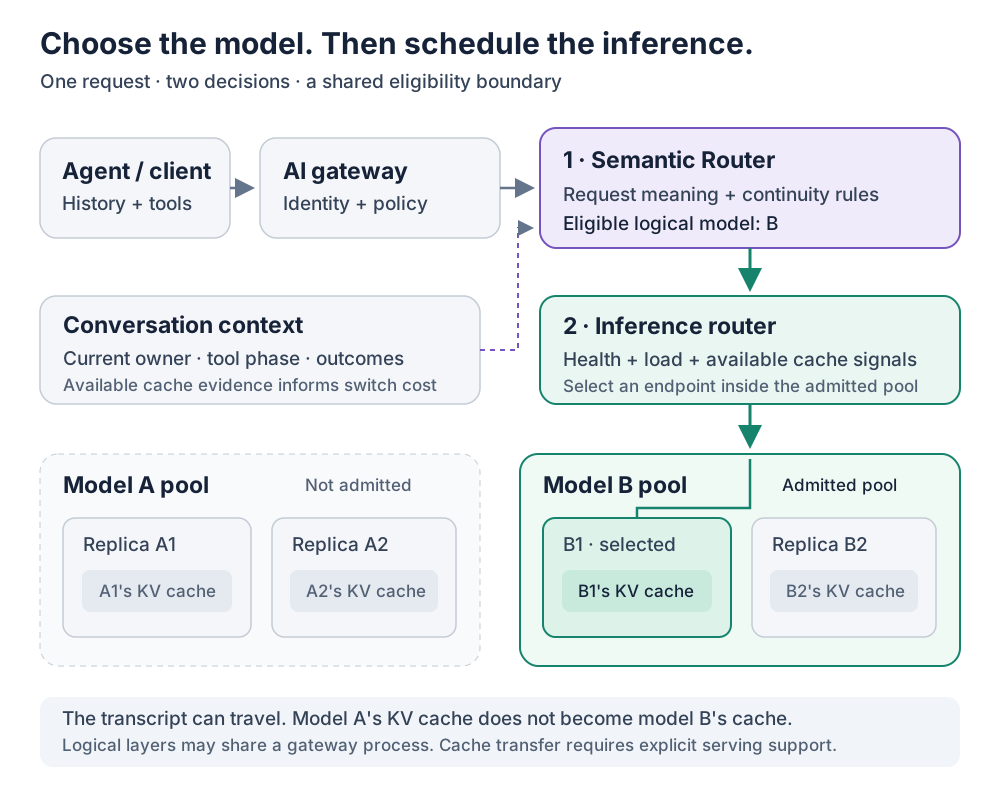
Figure 1: Choose an eligible model, then schedule inside its pool. These are logical boundaries; they may share a gateway process.
The agent supplies history and tool state. The gateway authenticates the request and preserves tenant-scoped conversation identity. Semantic Router, an Envoy external processor, selects an eligible model and applies continuity protection. The inference router picks a replica; the model server executes the request. The response returns to the agent, which owns tool execution and the next turn.
Three integration choices make this composition reliable:
- Choose who owns context. Preserve conversation identity across turns and decide where stored history is resolved. Test missing identity headers: protection can fail open when its configured headers are absent.
- Make the model-to-pool contract explicit. Carry the final model selection through the gateway. Assert endpoint membership and, for shared pools, model/adapter compatibility. A protected owner becoming unavailable needs explicit recovery—not an arbitrary fallback halfway through a tool loop.
- Trace the whole request. Join routing reason, final model, endpoint, token usage, cache evidence, latency, and task verdict. This separates a capability mismatch from a cold prefix or a busy replica.
What the live benchmarks showed
The frozen candidate, agentic-context/multiturn-switch@2026-10-dev1, ran
160 sessions and 960 calls using Qwen3-0.6B and Qwen3-8B
on two vLLM servers sharing one NVIDIA L40S, behind Envoy and Semantic Router.
Each of five policies received the same 16 held-out seeds across two six-turn
workloads: ordered state retention, and a one-off retrieval challenge followed
by easy acknowledgements. Thresholds were frozen before inspecting the holdout.
A recent-outcome gate can delay a proposed switch until observed outcomes justify it. Observe records its verdict without applying it; enforce applies it.
| Policy | Final-turn pass rate | Turn accuracy | Strong-model turns | Prefix-cache hit ratio | Mean latency/session |
|---|---|---|---|---|---|
| Strong model throughout | 100% | 66.7% | 100% | 80.8% | 1,793 ms |
| Small model throughout | 50.0% | 53.6% | 0% | 80.8% | 456 ms |
| Protection, gate disabled | 100% | 66.1% | 83.3% | 66.1% | 1,771 ms |
| Candidate gate, observe | 100% | 66.7% | 83.3% | 65.9% | 1,694 ms |
| Candidate gate, enforce | 90.6% | 69.3% | 51.6% | 64.8% | 1,221 ms |
Each arm contains 32 sessions and 192 calls. Final-turn pass rate is not whole-task accuracy: it checks ordered final synthesis in state retention, but only the closing acknowledgement in the retrieval workload. An acknowledgement can pass after a failed retrieval, which is why intermediate turn accuracy matters too.
Compared with the gate-disabled control, enforcement used fewer strong-model turns and finished faster, but final checks fell from 32/32 to 29/32. Its paired bootstrap 95% interval was [-21.9, 0.0] percentage points; the apparent turn-accuracy improvement was also inconclusive. The candidate did not meet our quality requirement and was rejected for enforcement.
These are controlled switching measurements, not semantic-classifier accuracy or production-scale throughput. Signals and proposals were controlled, calls were sequential, and outputs were short. Cache ratios were backend counter deltas averaged per session; strong-model share is a usage proxy, not measured dollar savings. A separate llm-d simulator test checks model/pool/endpoint composition, not real-GPU scheduling performance.
When should the conversation change models?
All three failed final checks came from state-retention sessions with the same schedule: three small-model turns, then three strong-model turns. The small model failed turn three; the stronger model received that answer in its history and continued. The final synthesis contained incorrectly ordered values.
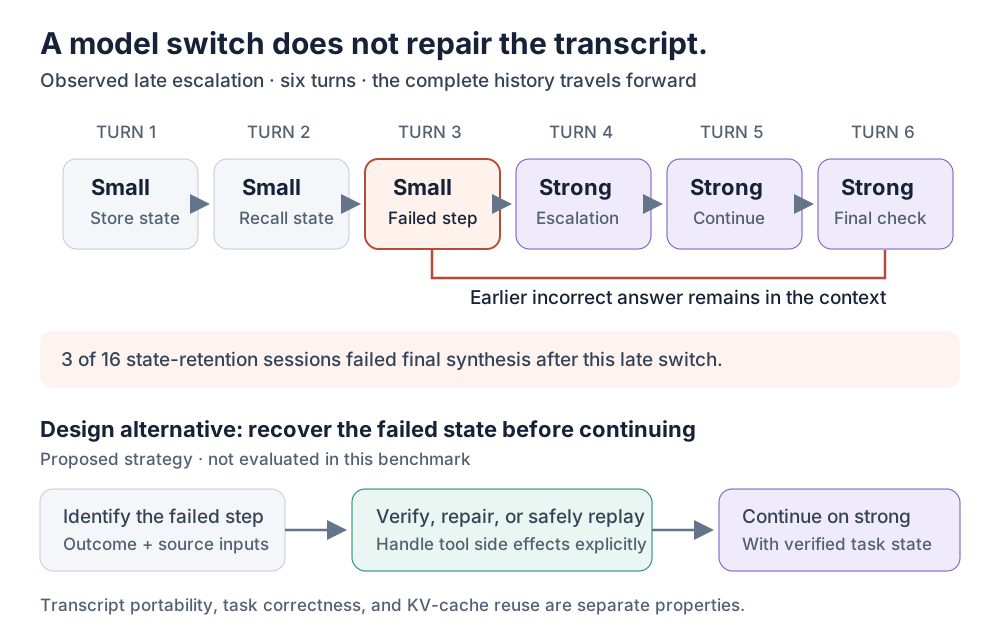
Figure 2: A switch changes the executor, not earlier answers. Repair is a proposed strategy, not a measured result.
The traces are consistent with late escalation carrying damaged state forward; they do not isolate that mechanism causally. Testing verification, state repair, or safe replay is the next step. Side-effecting tools need idempotency safeguards.
Timing also mattered in a separate native-tool benchmark. Across eight paired seeds, choosing the stronger model before a known tool boundary improved final success from 37.5% to 100%. The tradeoff was 52.5 percentage points more strong-model turns, 11.35 points lower prefix-cache hit ratio, and 1,275 ms more per session. The fixture supplied the boundary explicitly; predicting it in real applications remains work to do.
Together, these experiments suggest two distinct policies: select an appropriate owner before difficult work begins, and recover failed state rather than merely changing the model on the following turn.
What to measure in your own stack
Compare fixed strong and small models, per-turn routing, and continuity-protected routing on paired tasks with an untouched holdout. Then test endpoint scheduling separately, under realistic load. At minimum, check:
- Task correctness: final outcomes and intermediate errors, not just successful requests.
- Continuity: tool call/result sequences and stored-history portability.
- Serving behavior: eligible endpoint selection, warm/cold prefixes, time to first token, queue time, and latency percentiles.
- Failure recovery: owner loss, retries, and protection against duplicate tool side effects.
Run new gates in observe mode first. Set quality requirements before tuning for speed or model usage. The architectural payoff is a division of responsibility: Semantic Router decides what should do the work, the inference router decides where it should run, and task-level evaluation checks whether the combination actually finishes the job.
Start with a reproducible replay
From the repository root, with Python 3.10+ and jq, inspect the bundled coding-agent session without sending a request:
python3 bench/agent_session_replay.py --dry-run | \
  jq '{fixture, dry_run, tools, summary}'
It plans three requests with ten tools. To replay them through your own gateway:
python3 bench/agent_session_replay.py \
  --base-url http://127.0.0.1:8899/v1 \
  --session-id blog-replay-001 \
  --extra-header x-conversation-id=blog-replay-001
Match the identity headers to your protection configuration, use a fresh ID for
each comparison, and add --api-key-env when authentication is required.
What this replay measures—and what it does not
The fixture supplies the history: generated answers are not fed into later requests, and tools are not executed. It measures request shape and routing diagnostics, not completed-agent-task quality.
The current CLI counts HTTP 2xx as success, even for a malformed response body, and can exit zero while reporting a tool-loop switch violation. Check the report, including model identity on every turn. Dry-run zero switch counts are not continuity evidence. Missing cached-token detail is recorded as zero; use backend telemetry to distinguish missing data from no cache reuse.
For tasks where generated answers drive subsequent actions, use sr-bench's frozen-plan workflow and task reports. Default agent runs do not supply session identity; per-task identity is tracked separately. Do not treat those defaults as tests of session-scoped protection.
References and reproducibility
- Continuity protection, memory and Replay, and recent-outcome gates.
- Tool-loop ownership fix, Chat/Responses benchmark runner, coding-agent replay, and per-task continuity reporting.
- vLLM prefix caching and Gateway API Inference Extension.
- Evaluation record and holdout results.
Router revision:
0ee9955fc6ae0d79104e33bc933ae0f75ed52acf; Qwen3-0.6B:c1899de289a04d12100db370d81485cdf75e47ca; Qwen3-8B:b968826d9c46dd6066d109eabc6255188de91218.