跳到主要内容

10 篇博文 含有标签「routing」

查看所有标签

Agent skills for configuring and evaluating vLLM Semantic Router

· 阅读需 10 分钟
Anup Sharma
Engineering @ Sarvam AI
Park Soobin
Router Models & Inference Runtime Lead @ vLLM Semantic Router

We sent a coding question through a local vLLM Semantic Router. It came back HTTP 200 with the right route headers: the code-route decision and an upstream response path. It contained no answer. A 128-token cap had ended the backend's reply while it was still reasoning. Every check that looked only at the status code or the route passed; the user still got nothing.

That is the gap these skills address. A request reaches the Router through a public entrypoint. The Router evaluates signals, chooses a decision and algorithm, selects a backend, and applies recipe-scoped plugins. A useful assistant must know where in that chain an observation came from. A healthy process does not prove a request took the intended route, a correct route does not prove an answer arrived, and an improved benchmark score does not prove two runs were comparable.

We have started publishing focused agent skills for those jobs. They give a coding assistant a short workflow, point to the current commands and contracts, and say which evidence to preserve. This work was inspired by llm-d's skills article. Here, the unit of work follows the Semantic Router's entrypoint, recipe, decision model, and measured request. That scope matters: starting a process, selecting a route, delivering an answer, and measuring a workload are four different results.

To try one, give a coding agent with terminal access a one-line prompt:

Read https://vllm-sr.ai/install/agent/vllm-sr-serve/SKILL.md
and start a local CPU stack.

Swap in any skill from the table below. For the full install-to-tuning lifecycle, use the prompt in the agent installation guide.


vSR: vLLM Semantic Router Inside Claude Code

· 阅读需 19 分钟
Theo Hsiung
Associate Research Scientist @ Delta Electronics
Abhinav Mahajan
Software Engineer at Barclays

The vLLM Semantic Router mascot leads six bodyguards, one per vSR app, to the Claude Code mascot: a signpost for router, a ladder for escalate, a marker for redact, a shield for shield, a stop sign for guard and a magnifying glass for check.

A coding agent does three things all day: it hands work to subagents, it reads files, and it runs commands. Each one carries a cost that the session never shows you.

Subagents run at your model's price. A general-purpose subagent starts on your session's model. Listing files, counting lines or renaming a variable costs the same as a hard design question, because nothing asks how hard the task is before the subagent starts.

Reads carry more than code. The agent reads what it is pointed at: a support ticket with a customer's email and card number, a config file with an API key, a vendored README with an instruction to AI agents hidden in a comment. Whatever it reads becomes part of the conversation, and what a file says can steer what the agent does next.

Commands blur together. A long session runs dozens of Bash commands, and almost all of them are harmless. A git reset --hard chained with a force push is not, yet in a long run of prompts, or in auto mode with none at all, it looks like the rest.

Each of these is a routing question: which model should take this task, what in this output should the model never see, which command needs a person. vLLM Semantic Router answers questions like these for every request at the gateway. vSR asks them inside the coding agent, at the moment each one happens.

vSR is a Claude Code plugin that puts vLLM Semantic Router's decision model inside the harness. One small model, vela3-lite, answers the questions a router would ask: how hard is this task, is there personal data in this output, is this file trying to instruct the agent, does this command need a person. Your requests still go to Claude as usual.

One Conversation, Multiple Models: Runkite and vLLM Semantic Router

· 阅读需 15 分钟
Sharan Harsoor
Founder and maintainer of Runkite · ML Engineer

Runkite website · GitHub · Runnable example and recorded results

An incident investigation can begin with a small request: read the incident and tell me which service is affected. The next question asks why it is failing. Eventually, someone asks the agent to restart the service.

The conversation has moved from reading to reasoning to acting. Those requests can use different model routes, but changing the model should not change the agent's permission to act. And if the process running the agent restarts along the way, the next question still belongs to the same conversation.

That is the path I wanted to test by connecting Runkite with vLLM Semantic Router. Runkite's existing managed Vercel AI SDK runner would execute the agent. Semantic Router would select the model backend for its inference requests. The SDK would keep its native tool loop, while model selection would live in the router configuration.

I followed one conversation through three turns: read an incident, restart the runner and ask for a diagnosis, then request a service restart the agent was forbidden to perform. The incident and tool service are fictional. The model calls, streamed tool requests and durable results are real.

To understand the result, start with what happens between a user's question and an agent's answer.

Build Multi-Model LangGraph Agents with Aegra and vLLM Semantic Router

· 阅读需 13 分钟
Aayush Saini
SDE, Data and AI @ Red Hat

aegra×vLLM Semantic Router

Aegra × vLLM Semantic Router — agent runtime meets multi-model routing

Most LangGraph agents hardcode a single LLM. That forces bad tradeoffs: easy turns burn frontier spend, hard turns fail on a small model, and changing the fleet means editing graph code. Enterprises need something different—an agent runtime they own, plus a model decision layer that can classify each call and send it to the right backend.

This post shows how those layers fit together: Aegra for self-hosted Agent Protocol / LangGraph serving, and vLLM Semantic Router for programmable multi-model routing.

Decision Models Need a Router, Too

· 阅读需 9 分钟
Xunzhuo Liu
Intelligent Routing @vLLM | Open Source & AI @AMD
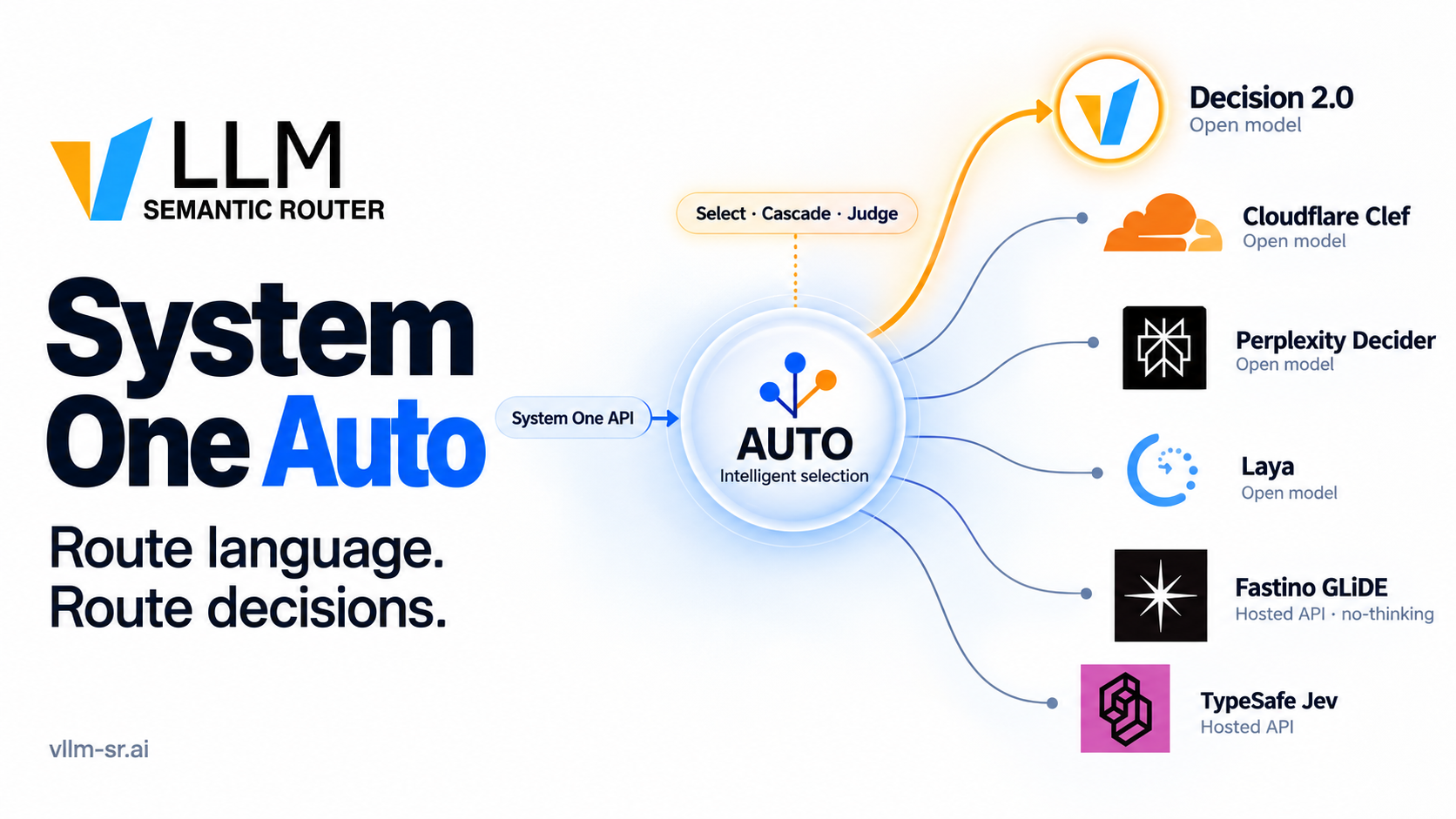
System One Auto intelligently selects from a decision-model pool. An Auto routing hub highlights a selected path among Decision 2.0, Cloudflare Clef, Perplexity Decider, Laya, Fastino GLiDE and TypeSafe Jev. Route language. Route decisions.

One API for a growing decision-model ecosystem. Provider logos illustrate the ecosystem; the experiment below measures Kai → Vega.

Save your largest decision model for the requests that need it.

vLLM Semantic Router already routes across open and closed LLMs. Decision models are becoming a model pool of their own. Open families such as Decision 2.0, Clef, Decider and Laya sit alongside hosted APIs such as Jev and GLiDE. They classify intent, score candidates and check conditions—but which model should handle each request?

Meet System One Auto. Connect self-hosted decision models or compatible hosted APIs behind vllm-sr/auto. Configure how to select a model, when to escalate through a cascade, and whether an LLM judge should review the final candidates. Your application keeps one native API; you choose the model pool and routing policy.

Beyond Prompt Routing: Model Selection, Conversation State, and KV Cache

· 阅读需 11 分钟
Anup Sharma
Engineering @ Sarvam AI
Stefan Wang
Senior Software Engineer at LinkedIn

An agent has completed three turns on model A. It has read a document, stored some facts, and started working toward an answer. The fourth turn needs stronger reasoning, so the router sends it to model B.

The request succeeds. But did the conversation improve?

Model B may receive the entire transcript and still inherit an incorrect answer. Its replica may have to compute the growing prompt again. If a tool call is in flight, changing models can also change how the result is interpreted.

We benchmarked these tradeoffs through vLLM Semantic Router, Envoy, and GPU-backed vLLM servers. In the 960-call holdout, one reactive switching policy reduced strong-model use by 31.8 percentage points and mean session latency by 550 ms compared with a gate-disabled control, but failed three final checks that the control passed. A separate native-tool experiment showed the benefit of choosing a capable model before a difficult boundary.

This is the problem beyond prompt classification: choosing the right model for the next turn without compromising the rest of the task. It also determines where semantic routing belongs in an existing inference stack.

Per-Call Model Selection: Measuring Cost and Quality Across a Multi-Agent Run

· 阅读需 15 分钟
Abhinav Mahajan
Software Engineer at Barclays

Every multi-agent framework asks one question before the first task arrives: which model does each agent use?

planner = Agent(role="planner", model="small-model")
summarizer = Agent(role="summarizer", model="small-model")
reviewer = Agent(role="reviewer", model="frontier-model")
writer = Agent(role="writer", model="small-model")

It looks like configuration. It is really a prediction, made once, about work nobody has seen yet.

A task never reaches a model as one request. It arrives as a stream of calls: list the changed files, summarize a module, search for a concurrency bug, write the final comment. Bind a model to an agent and every one of those calls gets the same answer, hard or trivial.

vLLM Semantic Router moves that choice onto the request. Every agent sends one model name, MoM, short for mixture of models. It is not a model but a virtual name the router resolves per call, from what the call contains, using signals and decisions written in YAML. Throughout this post, local means a small model on your own machine, free and slower, and frontier means a large hosted model, billed per token and fast.

To see what changes, we ran one four-agent crew four ways, all frontier, model per agent, model per call and all local, recording every call: which model served it, which decision chose it, what it cost, and how long the router took to decide.

Per-call routing sent 2 of 16 calls to the frontier model and cost $1.37 per 1,000 reviews. That is one fifth the cost of sending everything to the frontier model, and less than half the cost of a hand-tuned per-agent setup. It found 4 of 6 seeded bugs, matching the all-frontier arm and beating per-agent binding, which found 3. The router took 1.86 ms at p50 to make each choice.

Adding Cursor-Style Auto Model Selection to OpenCode with vLLM Semantic Router

· 阅读需 11 分钟
Anup Sharma
Engineering @ Sarvam AI
Aayush Saini
SDE, Data and AI @ Red Hat
Shivji Kumar Jha
Staff Engineer (Data & AI) @ Nutanix

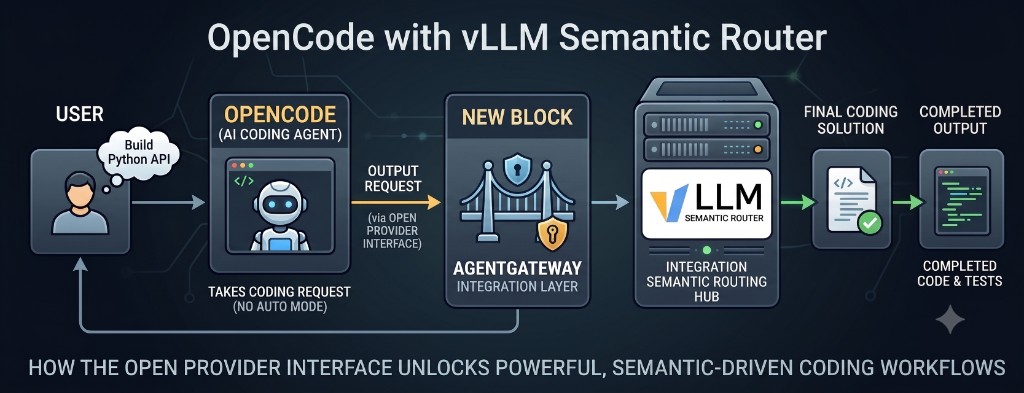
OpenCode with vLLM Semantic Router: open provider interface, AgentGateway integration layer, and semantic routing hub

The Feature Everyone Wants and Almost Nobody Has​

Cursor's Auto mode is deceptively simple: the developer types, and the IDE chooses whether a prompt deserves a frontier model or something faster and cheaper. It is easy to stop noticing — until moving to an open tool where every request starts with a model dropdown.

Giving AgentGateway a Semantic Brain with vLLM Semantic Router

· 阅读需 10 分钟
Aayush Saini
SDE, Data and AI @ Red Hat
Anup Sharma
Engineering @ Sarvam AI

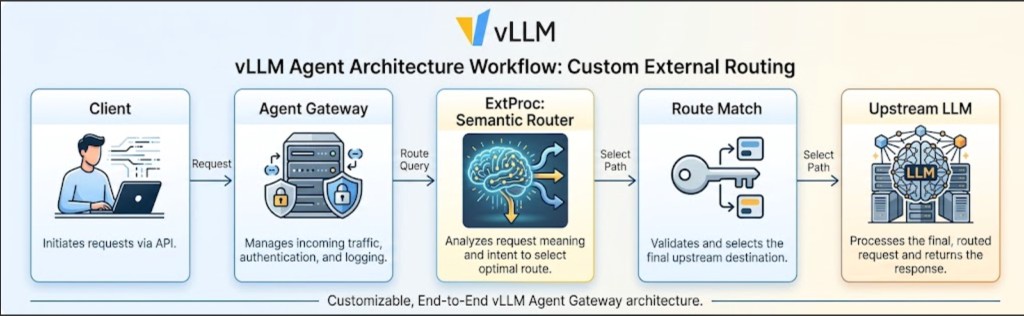
vLLM Agent Architecture Workflow: Custom Semantic Routing with AgentGateway and Semantic Router

Agent systems that span multiple models — a local endpoint for coding, a frontier cloud model for deep reasoning, and a fast general-purpose model for everyday tasks — all face the same routing question: how should each request be directed to the right backend?

Many deployments start with a lightweight Python proxy or keyword matcher in front of the gateway. That approach works at small scale, but misroutes grow quickly as traffic, languages, and task types diversify. This post shows how vLLM Semantic Router running as an Envoy ExtProc sidecar inside AgentGateway replaces that pattern with semantic, config-driven routing.

Agentic Routing on AMD ROCm

· 阅读需 14 分钟
Xunzhuo Liu
Intelligent Routing @vLLM | Open Source & AI @AMD
Haichen Zhang
Sr. AI Engineer @AMD
Andy Luo
Sr. Director @AMD

Most agent systems start with a simple idea: call model: auto and let the inference layer pick the right model. That is useful, but it is not enough for long-running agents.

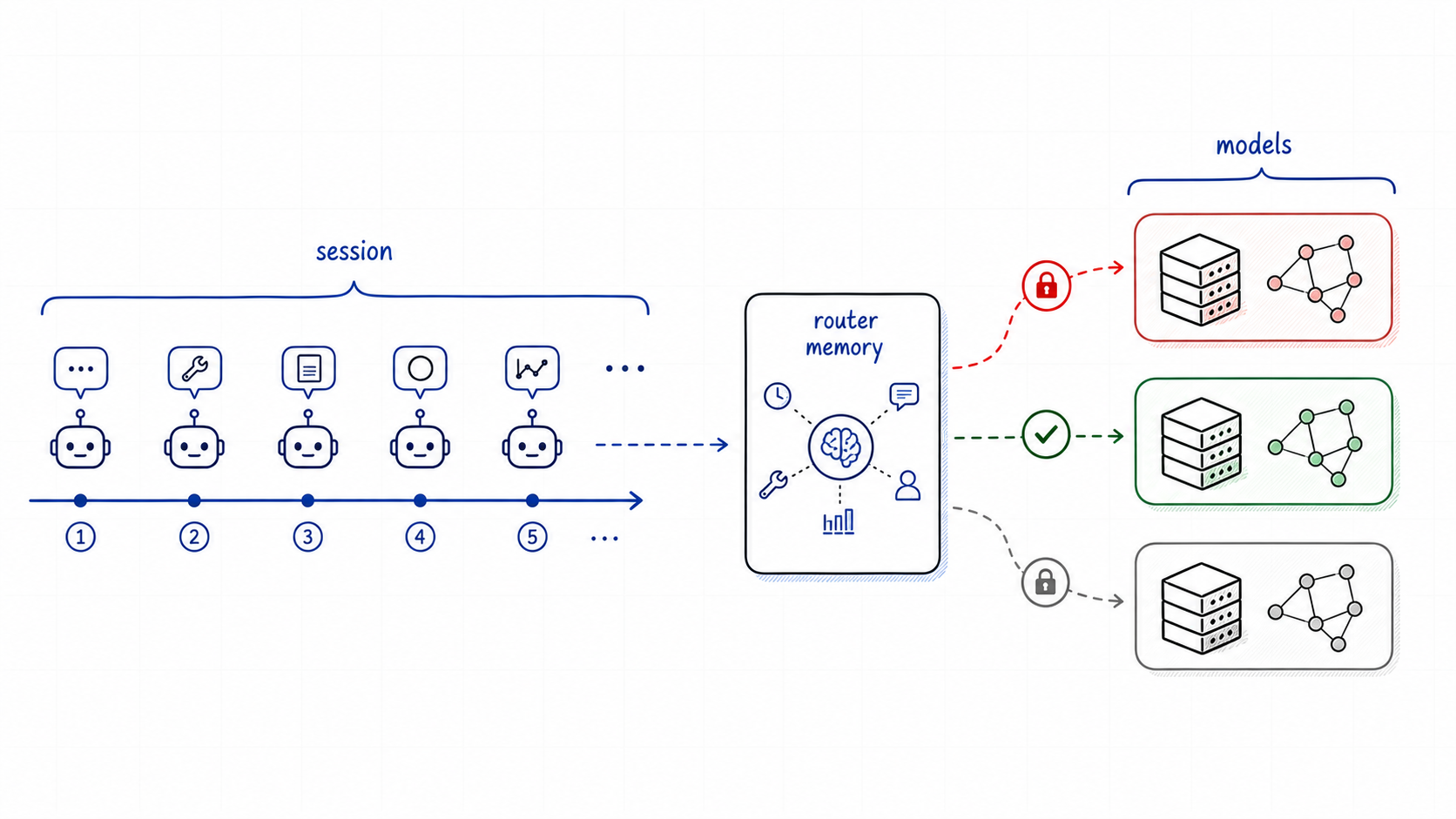
A coding agent can begin with architecture work, call tools, receive short tool outputs, continue with "fix that", then ask a privacy-sensitive question in the same user session. The latest message may look simple, but the route cannot be chosen from the latest message alone. The router also has to know whether this is a safe moment to switch models.

This guide shows how to deploy that pattern on AMD ROCm with vLLM Semantic Router. You will start one ROCm vLLM backend, serve the agentic routing recipe, open the dashboard, validate the OpenAI-compatible API, and use Inferoa to experience route decisions and Router Learning behavior from an agent client.

Agent session routed through router memory to model paths
Agentic routing is not only choosing a model. It is choosing when to keep one.