Build Multi-Model LangGraph Agents with Aegra and vLLM Semantic Router



Aegra × vLLM Semantic Router — agent runtime meets multi-model routing
Most LangGraph agents hardcode a single LLM. That forces bad tradeoffs: easy turns burn frontier spend, hard turns fail on a small model, and changing the fleet means editing graph code. Enterprises need something different—an agent runtime they own, plus a model decision layer that can classify each call and send it to the right backend.
This post shows how those layers fit together: Aegra for self-hosted Agent Protocol / LangGraph serving, and vLLM Semantic Router for programmable multi-model routing.
The problem: agents and models are different layers
An enterprise agent has to do more than call chat.completions once:
- Keep a long conversation alive across tools and human approvals
- Survive process crashes and redeploys
- Scope state to a user or tenant
- Plan, delegate, and work over many steps
Separately, each LLM call inside that agent has its own economics:
- Greeting vs. debugging vs. legal analysis need different models
- Local GPUs, private vLLM, and cloud APIs have different cost and residency rules
- Quality, latency, and spend should be policy—not hardcoded in a node
Hardcoding one model into the graph conflates those problems. Aegra owns the agent lifecycle. vLLM Semantic Router owns which model answers each request.
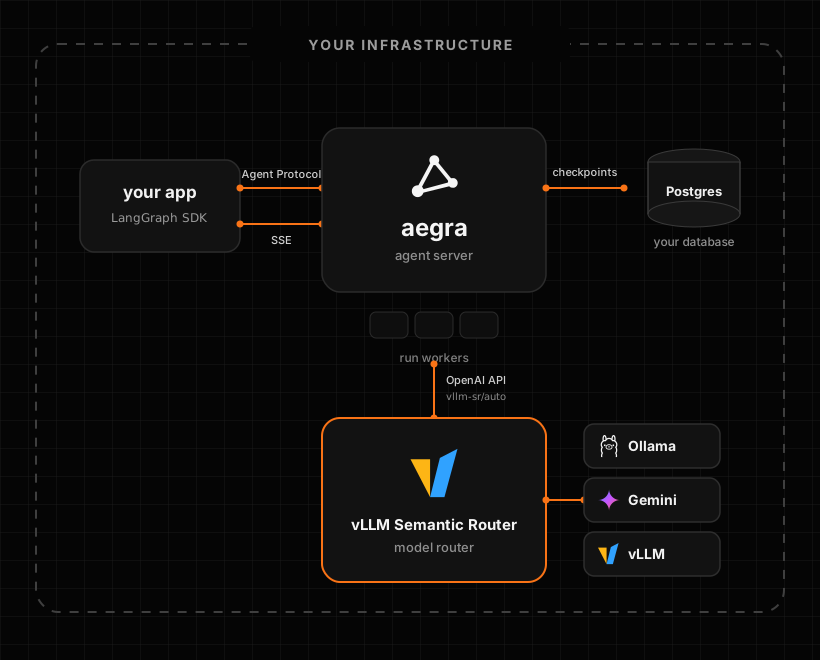
Aegra stays the agent server (threads, workers, checkpoints). The one extra hop is vLLM Semantic Router: every vllm-sr/auto call is classified and sent to the right backend.
What is Aegra?
Aegra is an open-source Agent Protocol server—a self-hosted alternative to managed LangGraph / LangSmith Deployments. You keep the same LangGraph SDK; you change the URL to your own infrastructure.
Out of the box it gives you:
| Capability | Why it matters |
|---|---|
| Your Postgres | Threads, runs, and checkpoints live in a database you control—region, backups, SQL access |
| Agent Protocol API | threads, runs/stream, state, assistants, store, crons—the surface Agent Chat UI and LangGraph Studio already speak |
| Workers that survive restarts | Redis queue with leases and crash recovery; scale by adding instances |
| Custom auth in Python | JWT, OAuth, Firebase; threads scoped to owners |
| Streaming | SSE token / value / event streams, including Agent Protocol v2 thread-scoped streaming |
| OTLP tracing | Langfuse, Phoenix, or your collector |
Aegra does not decide whether turn N should use Gemini Flash or a local coder. That is the Router’s job.
How Aegra helps companies (and who uses it)
Companies adopt Aegra when they want LangGraph-class agents without handing thread state, auth, and data residency to a vendor-only control plane.
Public production stories from the Aegra homepage include:
| Organization | How they use Aegra |
|---|---|
| Mercanis | Procurement / AI platform team; chose Aegra to escape managed-platform lock-in and contribute upstream |
| tmarket.io | Runs Aegra on Kubernetes for their AI stack; cites concurrent load and reliability for inventory mapping at scale |
| Diag n'Grow | Data-collection chatbot (replacing fixed questionnaires) and a software audit agent |
| ROQ Markets / ROQ Capital | Core component of agentic AI infrastructure for an AI-powered investment platform—flexibility and control while staying in the LangGraph ecosystem |
| Ingenix.AI and others | Production agents with strong developer experience on self-hosted stacks |
The pattern is the same: agents in production, on infra they operate, with portable SDK clients.
What are Deep Agents?
A shallow agent is “LLM + tools in a loop.” It works for short tasks and fails when the work is long, branched, or context-heavy.
Deep Agents (LangChain’s agent harness on LangGraph) add the pieces that make long-horizon work reliable:
- Planning — decompose goals and track progress
- Subagents — delegate with isolated context windows
- Filesystem / skills / memory — persist artifacts and recall across steps
- Context management — summarize, offload large tool results
- Human-in-the-loop — pause for approval on risky actions
Deep Agents still need a runtime (threads, checkpoints, streaming) and still emit many LLM calls. Aegra is a natural host for that runtime. vLLM Semantic Router is a natural front door for those LLM calls: each planning step, tool-loop turn, or subagent prompt can hit a different physical model under one logical name like vllm-sr/auto.
Why threads and checkpoints matter
In Aegra, a thread is the durable conversation unit: messages, graph state, interrupts, and ownership. Runs execute inside threads. See Threads and state.
A checkpoint is a snapshot after graph steps. That is what makes enterprise agents operable:
| Need | What checkpoints / threads enable |
|---|---|
| Crash recovery | Resume from the last durable step instead of restarting the whole agent |
| Human-in-the-loop | Interrupt, wait for approval, continue the same thread |
| Time travel / branch | Replay or fork from an earlier checkpoint_id |
| Audit & compliance | Inspect history: who ran what, with which state |
| Multi-tenant isolation | Auth-scoped threads; users only see their own work |
| Cost control | TTL / prune policies so long agent histories do not grow forever |
Without threads and checkpoints, “enterprise agent” is a demo script. With them, you get durable, inspectable, recoverable work—the difference between a chat toy and a production system.
Durability modes (sync, async, exit) let you trade step-level recoverability for throughput. Deep Agents’ delta-channel state has special TTL considerations; Aegra documents those explicitly so operators do not silently drop history they still need.
Why connect Aegra to vLLM Semantic Router?
Aegra answers: How do we run and persist the agent?
Semantic Router answers: Which model should serve this call under our policy?
Point the agent’s OpenAI-compatible client at the Router listener (for example http://localhost:8899) and use a logical model such as vllm-sr/auto. The graph stays simple; the fleet stays flexible.
What the Router adds
- Signals — domain, complexity, safety, PII, conversation features, and more
- Decisions — named policies with priority (for example “code → Gemini”, “chat → local”)
- Algorithms — static, cascade, hybrid, session-aware selection, and others
- Backends — Ollama, vLLM, Gemini, OpenAI, private endpoints—under one API
A concrete local pattern (from the workflow we exercised while drafting this post):
| Domain signal | Decision | Backend |
|---|---|---|
computer science | code-to-gemini | Gemini Flash-Lite |
math | math-to-gemini | Gemini Flash-Lite |
| fallback | default-ollama | Local Ollama |
Preview without generating an answer:
curl -s 'http://localhost:8080/api/v1/routing/preview?trace=true' \
  -H 'Content-Type: application/json' \
  -d '{"model":"vllm-sr/auto","text":"Help me debug this Python program."}' \
  | python3 -m json.tool
You should see something like decision_name: code-to-gemini, domain confidence near 1.0, and selected_model pointing at your cloud coder—while a greeting falls through to the local model. Response headers on live chat (x-vsr-selected-decision, x-vsr-selected-model, x-vsr-matched-domains) make the same decision visible to Aegra-side traces and support tooling.
For long-running agents, pair this with session-aware agentic routing: send a stable x-session-id (often the Aegra thread_id) so tool loops and provider state do not break when the policy would otherwise switch models mid-turn.
End-to-end: the enterprise agent stack
Putting it together:
- Client creates an Aegra thread (per user / ticket / deal).
- Aegra runs a LangGraph or Deep Agent: plan → tools → maybe HITL → continue.
- Every LLM call goes to Semantic Router as
vllm-sr/auto(or a named virtual model). - Router classifies the nature of that turn (domain, difficulty, safety), matches a decision, and selects a backend.
- Checkpoints persist agent state in Postgres; Router headers / preview persist why a model was chosen.
- Operators tune
config.yaml(or the Dashboard) to change fleet policy without redeploying the graph.
That is an end-to-end enterprise agent: durable orchestration on infra you own, plus explainable multi-model inference under policy.
# Aegra side: same LangGraph SDK, your URL
from langgraph_sdk import get_client

client = get_client(url="https://agents.yourcompany.com")
thread = await client.threads.create(metadata={"tenant": "acme", "case": "INC-2044"})

# Inside the graph's LLM client (conceptual):
#   base_url = "https://router.yourcompany.com"  # vLLM Semantic Router
#   model = "vllm-sr/auto"
#   extra_headers = {"x-session-id": thread["thread_id"]}
Tradeoffs and caveats
- Two control planes — Aegra for agent ops; Router for model ops. Own both configs deliberately.
- Protocol quirks — some providers’ OpenAI-compat responses need models/Router versions that tolerate vendor usage fields (we hit this with full Gemini Flash on older Router releases; Flash-Lite was a practical workaround).
- Reachability — from Docker, use
host.docker.internal(or service DNS) for Ollama/vLLM; cloud keys viaapi_key_env, never committed YAML. - Deep Agents + TTL — DeltaChannel state may skip certain prune strategies; read Aegra’s checkpoint TTL notes before aggressive compaction.
- Session continuity — prefer Router session awareness when tool loops span multiple LLM calls.
What to build next
- Run Aegra against your Postgres (aegra.dev).
- Run
vllm-sr servewith at least two backends and domain (or decision) signals. - Point the agent LLM client at the Router; use
vllm-sr/auto. - Pass
thread_idasx-session-idfor multi-turn agents. - Use Router preview +
x-vsr-*headers in staging until the decision policy matches product intent.
Worked example: support agent on Aegra + Router
Here is a minimal local path that matches the checklist—Aegra for the thread, Semantic Router for every LLM call.
1. Router config (two backends + domain decisions)
Keep a small fleet: local Ollama for chat, Gemini for code/math. Sketch:
providers:
  models:
    - name: llama3.2:3b
      backend_refs:
        - name: local-ollama
          endpoint: host.docker.internal:11434
          provider: ollama
    - name: gemini-2.5-flash-lite
      backend_refs:
        - name: google-gemini
          provider: gemini
          base_url: https://generativelanguage.googleapis.com/v1beta/openai
          api_key_env: GEMINI_API_KEY

routing:
  signals:
    domains:
      - name: computer science
        mmlu_categories: [computer science]
      - name: math
        mmlu_categories: [math]
  decisions:
    - name: code-to-gemini
      priority: 200
      rules:
        conditions: [{ type: domain, name: computer science }]
      modelRefs: [{ model: gemini-2.5-flash-lite }]
    - name: default-ollama
      priority: 100
      rules: { conditions: [] }
      modelRefs: [{ model: llama3.2:3b }]
Then start the stack (listener on 8899, management often on 8080):
export GEMINI_API_KEY=...   # never commit this
vllm-sr serve --config config.yaml
2. Preview the policy before wiring the agent
# Should match code-to-gemini → gemini-2.5-flash-lite
curl -s 'http://localhost:8080/api/v1/routing/preview?trace=true' \
  -H 'Content-Type: application/json' \
  -d '{"model":"vllm-sr/auto","text":"Help me debug this Python race condition."}' \
  | python3 -m json.tool

# Should fall through to default-ollama → llama3.2:3b
curl -s 'http://localhost:8080/api/v1/routing/preview?trace=true' \
  -H 'Content-Type: application/json' \
  -d '{"model":"vllm-sr/auto","text":"Thanks — talk later."}' \
  | python3 -m json.tool
3. Aegra thread + LLM client pointed at the Router
Create a durable thread in Aegra, then make every graph LLM call use vllm-sr/auto with that thread_id as x-session-id:
import os
from langgraph_sdk import get_client
from langchain_openai import ChatOpenAI

# Agent runtime you own
aegra = get_client(url=os.environ["AEGRA_URL"])  # e.g. http://localhost:8000
thread = await aegra.threads.create(
    metadata={"tenant": "acme", "case": "INC-2044"},
)
session_id = thread["thread_id"]

# Model brain: one logical name, many physical backends
llm = ChatOpenAI(
    base_url="http://localhost:8899/v1",
    api_key="not-needed",  # backends use their own keys via api_key_env
    model="vllm-sr/auto",
    default_headers={"x-session-id": session_id},
)

# Use `llm` inside your LangGraph / Deep Agent nodes.
# Aegra still owns checkpoints; Router owns which model answers each turn.
4. Confirm live routing with response headers
On a real chat completion through the Router, inspect:
| Header | What it tells you |
|---|---|
x-vsr-selected-decision | Which decision fired (code-to-gemini, default-ollama, …) |
x-vsr-selected-model | Physical model that answered |
x-vsr-matched-domains | Domains the classifier saw |
In staging, iterate: change prompts → preview → adjust decisions → re-check headers until product intent matches. Only then point production Aegra graphs at the same Router URL.
5. Smoke-test the loop end-to-end
Client → Aegra (thread INC-2044)
       → graph node calls ChatOpenAI(model=vllm-sr/auto, x-session-id=thread_id)
       → Semantic Router classifies + selects backend
       → Ollama or Gemini answers
       → Aegra checkpoints state in Postgres
If a tool loop spans many LLM calls, keep the same x-session-id for the life of the thread so session-aware routing does not thrash models mid-case.
Closing
Aegra gives companies a self-hosted LangGraph / Deep Agent runtime—threads, checkpoints, auth, workers—used in production by teams like Mercanis, tmarket, Diag n'Grow, and ROQ Markets. vLLM Semantic Router gives those agents a programmable model brain: classify the nature of each request and route it to the right compute.
Connect them, and you stop choosing between “one expensive model everywhere” and “fragile if/else in the graph.” You get durable enterprise agents—and decisions you can explain.