21 posts tagged with "semantic-router"

View All Tags

Agent skills for configuring and evaluating vLLM Semantic Router

· 10 min read
Anup Sharma
Engineering @ Sarvam AI
Park Soobin
Router Models & Inference Runtime Lead @ vLLM Semantic Router

We sent a coding question through a local vLLM Semantic Router. It came back HTTP 200 with the right route headers: the code-route decision and an upstream response path. It contained no answer. A 128-token cap had ended the backend's reply while it was still reasoning. Every check that looked only at the status code or the route passed; the user still got nothing.

That is the gap these skills address. A request reaches the Router through a public entrypoint. The Router evaluates signals, chooses a decision and algorithm, selects a backend, and applies recipe-scoped plugins. A useful assistant must know where in that chain an observation came from. A healthy process does not prove a request took the intended route, a correct route does not prove an answer arrived, and an improved benchmark score does not prove two runs were comparable.

We have started publishing focused agent skills for those jobs. They give a coding assistant a short workflow, point to the current commands and contracts, and say which evidence to preserve. This work was inspired by llm-d's skills article. Here, the unit of work follows the Semantic Router's entrypoint, recipe, decision model, and measured request. That scope matters: starting a process, selecting a route, delivering an answer, and measuring a workload are four different results.

To try one, give a coding agent with terminal access a one-line prompt:

Read https://vllm-sr.ai/install/agent/vllm-sr-serve/SKILL.md
and start a local CPU stack.

Swap in any skill from the table below. For the full install-to-tuning lifecycle, use the prompt in the agent installation guide.


vSR: vLLM Semantic Router Inside Claude Code

· 19 min read
Theo Hsiung
Associate Research Scientist @ Delta Electronics
Abhinav Mahajan
Software Engineer at Barclays

The vLLM Semantic Router mascot leads six bodyguards, one per vSR app, to the Claude Code mascot: a signpost for router, a ladder for escalate, a marker for redact, a shield for shield, a stop sign for guard and a magnifying glass for check.

A coding agent does three things all day: it hands work to subagents, it reads files, and it runs commands. Each one carries a cost that the session never shows you.

Subagents run at your model's price. A general-purpose subagent starts on your session's model. Listing files, counting lines or renaming a variable costs the same as a hard design question, because nothing asks how hard the task is before the subagent starts.

Reads carry more than code. The agent reads what it is pointed at: a support ticket with a customer's email and card number, a config file with an API key, a vendored README with an instruction to AI agents hidden in a comment. Whatever it reads becomes part of the conversation, and what a file says can steer what the agent does next.

Commands blur together. A long session runs dozens of Bash commands, and almost all of them are harmless. A git reset --hard chained with a force push is not, yet in a long run of prompts, or in auto mode with none at all, it looks like the rest.

Each of these is a routing question: which model should take this task, what in this output should the model never see, which command needs a person. vLLM Semantic Router answers questions like these for every request at the gateway. vSR asks them inside the coding agent, at the moment each one happens.

vSR is a Claude Code plugin that puts vLLM Semantic Router's decision model inside the harness. One small model, vela3-lite, answers the questions a router would ask: how hard is this task, is there personal data in this output, is this file trying to instruct the agent, does this command need a person. Your requests still go to Claude as usual.

One Conversation, Multiple Models: Runkite and vLLM Semantic Router

· 15 min read
Sharan Harsoor
Founder and maintainer of Runkite · ML Engineer

Runkite website · GitHub · Runnable example and recorded results

An incident investigation can begin with a small request: read the incident and tell me which service is affected. The next question asks why it is failing. Eventually, someone asks the agent to restart the service.

The conversation has moved from reading to reasoning to acting. Those requests can use different model routes, but changing the model should not change the agent's permission to act. And if the process running the agent restarts along the way, the next question still belongs to the same conversation.

That is the path I wanted to test by connecting Runkite with vLLM Semantic Router. Runkite's existing managed Vercel AI SDK runner would execute the agent. Semantic Router would select the model backend for its inference requests. The SDK would keep its native tool loop, while model selection would live in the router configuration.

I followed one conversation through three turns: read an incident, restart the runner and ask for a diagnosis, then request a service restart the agent was forbidden to perform. The incident and tool service are fictional. The model calls, streamed tool requests and durable results are real.

To understand the result, start with what happens between a user's question and an agent's answer.

Build Multi-Model LangGraph Agents with Aegra and vLLM Semantic Router

· 13 min read
Aayush Saini
SDE, Data and AI @ Red Hat

aegra×vLLM Semantic Router

Aegra × vLLM Semantic Router — agent runtime meets multi-model routing

Most LangGraph agents hardcode a single LLM. That forces bad tradeoffs: easy turns burn frontier spend, hard turns fail on a small model, and changing the fleet means editing graph code. Enterprises need something different—an agent runtime they own, plus a model decision layer that can classify each call and send it to the right backend.

This post shows how those layers fit together: Aegra for self-hosted Agent Protocol / LangGraph serving, and vLLM Semantic Router for programmable multi-model routing.

Vela 3.0: name it, Vela finds it

· 38 min read
Ádám Kovács
Co-founder @ KR Labs · LettuceDetect
Xunzhuo Liu
Intelligent Routing @vLLM | Open Source & AI @AMD

Six open models. Decisions and spans in one call. Sound on.

Name it. Vela finds it. Decisions and the spans you name, in one call.

Vela 3.0 is a family of six open models for the vLLM Semantic Router, from a 0.3B encoder that reads images to a 27B model. Each one reads a request once and returns the router's decisions and the exact spans you name: personal data, unsupported claims, evidence, entities and relations. Its default router, vela3-fast, is a 380M UltraBERT encoder with the highest public Decision Index of any model up to 500M parameters: 50.36. Across the family, entities are at GLiNER level, and from 4B up classification and relations are at or above every model the GLiFormer paper reports, prompted Gemma-4-31B, GPT-OSS-120B and GPT-5-mini included.

Vela 3.0 is the next step from Vela 2.0: the same system_one interface, scaled at once in backbone, decisions, sizes, modality, languages and tasks.

Explore the six models → · Read about Vela 2.0 →

OSPP2026: Multi-Architecture Runtime Support for vLLM Semantic Router

· 12 min read

Two requests sent from the official Dashboard Playground to the native X60 Router. Each response shows the selected model, decision and routing latency. The test backend returns a fixed ok.

The standalone Router builds and runs on a SpacemiT X60 RISC-V server. On openKylin 2.0 SP1, the container passed eight routing and restart checks. With a two-CPU limit and concurrency 4–64, it handled about 270–280 requests/s in a short keyword/default-routing workload.

This work is part of OSPP project 2647b0097, 面向多架构环境的 vLLM Semantic Router 运行支持. It covers the Go Router and its container build. Model inference remains external. The port is proposed in PR #5259, with experimental platform status.

Decision 3.0 on Apple Silicon: Text, Image and Video Decisions on a Mac

· 8 min read
Alex Weng
Fluid Inference

d3-lite sorts 1,000 sample pull requests into the vLLM-SR workgroups, on an M5 Pro. Right: GPU load and the per-PR log.

Decision 3.0 runs on a Mac.

Decision 3.0 brought text, image and video decisions to one open model family. We converted the three smaller sizes (d3-lite 0.8B, d3-nano 2B and d3-mini 4B) to Core ML and built demos for text, screenshots and live video. Later we added d3-flash 9B, which plays Super Mario Bros. and taught d3-lite to do the same.

A decision made on the Mac has no per-call cost and no network round trip, and the pull request, web page or video never leaves the machine. That fits alongside vLLM-SR: routine decisions can be answered on the device, and the ones that need a bigger model can go to the router.

Get the Core ML models → · Swift runtime → · Watch the demo on X →

Decision Models Need a Router, Too

· 9 min read
Xunzhuo Liu
Intelligent Routing @vLLM | Open Source & AI @AMD
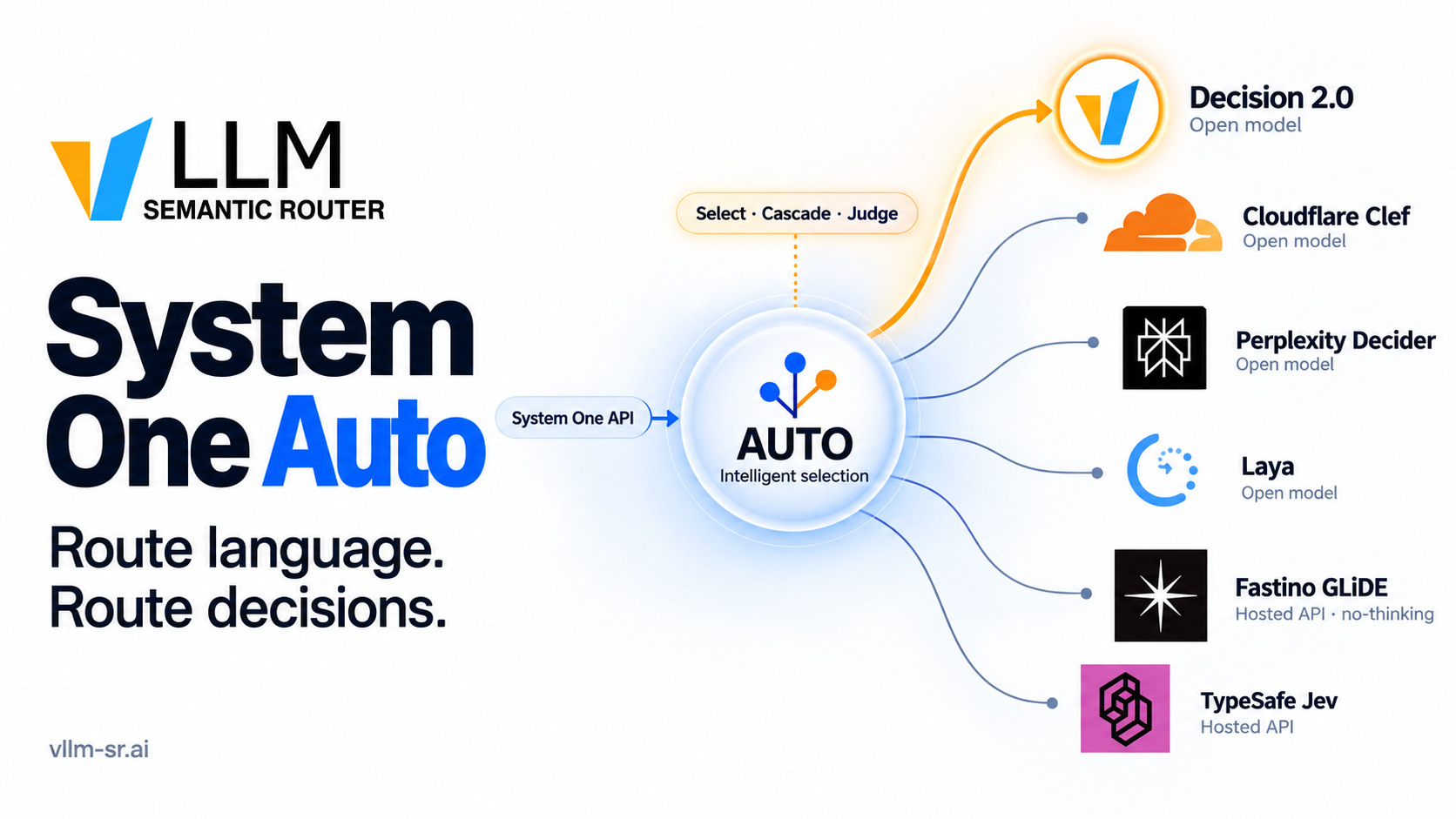
System One Auto intelligently selects from a decision-model pool. An Auto routing hub highlights a selected path among Decision 2.0, Cloudflare Clef, Perplexity Decider, Laya, Fastino GLiDE and TypeSafe Jev. Route language. Route decisions.

One API for a growing decision-model ecosystem. Provider logos illustrate the ecosystem; the experiment below measures Kai → Vega.

Save your largest decision model for the requests that need it.

vLLM Semantic Router already routes across open and closed LLMs. Decision models are becoming a model pool of their own. Open families such as Decision 2.0, Clef, Decider and Laya sit alongside hosted APIs such as Jev and GLiDE. They classify intent, score candidates and check conditions—but which model should handle each request?

Meet System One Auto. Connect self-hosted decision models or compatible hosted APIs behind vllm-sr/auto. Configure how to select a model, when to escalate through a cascade, and whether an LLM judge should review the final candidates. Your application keeps one native API; you choose the model pool and routing policy.

Vela 2.0: Open Foundation Routing Models

· 24 min read
Ádám Kovács
Co-founder @ KR Labs · LettuceDetect
Xunzhuo Liu
Intelligent Routing @vLLM | Open Source & AI @AMD

Still one model. Still one request. Now with spans. Sound on.

Open Foundation Routing Models. Bringing span-level decisions to System One.

Vela 2.0 is a family of open models for routing, safety checks and span-level decisions. Define your options, labels and rubrics at request time; get structured answers with probabilities and character-offset spans through one SystemOne-compatible interface.

Explore the four models → · Read about Decision →

Per-Call Model Selection: Measuring Cost and Quality Across a Multi-Agent Run

· 15 min read
Abhinav Mahajan
Software Engineer at Barclays

Every multi-agent framework asks one question before the first task arrives: which model does each agent use?

planner = Agent(role="planner", model="small-model")
summarizer = Agent(role="summarizer", model="small-model")
reviewer = Agent(role="reviewer", model="frontier-model")
writer = Agent(role="writer", model="small-model")

It looks like configuration. It is really a prediction, made once, about work nobody has seen yet.

A task never reaches a model as one request. It arrives as a stream of calls: list the changed files, summarize a module, search for a concurrency bug, write the final comment. Bind a model to an agent and every one of those calls gets the same answer, hard or trivial.

vLLM Semantic Router moves that choice onto the request. Every agent sends one model name, MoM, short for mixture of models. It is not a model but a virtual name the router resolves per call, from what the call contains, using signals and decisions written in YAML. Throughout this post, local means a small model on your own machine, free and slower, and frontier means a large hosted model, billed per token and fast.

To see what changes, we ran one four-agent crew four ways, all frontier, model per agent, model per call and all local, recording every call: which model served it, which decision chose it, what it cost, and how long the router took to decide.

Per-call routing sent 2 of 16 calls to the frontier model and cost $1.37 per 1,000 reviews. That is one fifth the cost of sending everything to the frontier model, and less than half the cost of a hand-tuned per-agent setup. It found 4 of 6 seeded bugs, matching the all-frontier arm and beating per-agent binding, which found 3. The router took 1.86 ms at p50 to make each choice.